Your cart is empty.
Browse products

Blog
AS 1319 Explained: A Plain-English Guide to Australia’s Safety Sign Standard
If you manage a workplace in Australia, you've probably heard of AS 1319 — the Australian Standard governing workplace safety signs. It sets clear rules for design, colour, shape, and placement so safety signs communicate hazards instantly. Following AS 1319 helps meet WHS obligations and ensures consistent safety communication across workplaces.
If you manage a workplace in Australia, you’ve probably heard of AS 1319 — the Australian Standard governing workplace safety signs. It sets clear rules for design, colour, shape, and placement so safety signs communicate hazards instantly. Following AS 1319 helps meet WHS obligations and ensures consistent safety communication across workplaces.
Key points in this article
- AS 1319 defines design, colour, symbols, and placement rules for safety signs
- Compliance is voluntary but strongly tied to WHS legal duties
- Six main sign categories cover all workplace hazard communication needs
- Correct sizing is based on viewing distance (15mm and 4mm rules)
- Material choice depends on environment, not the standard itself
What Is AS 1319?
AS 1319-1994 — Safety Signs for the Occupational Environment sets out how safety signs should be designed and used in Australian workplaces. It defines sign categories, specifies their colours, shapes and symbols, and sets rules for sizing and placement so signs are readable and instantly recognisable.
Is Compliance Mandatory?
Technically, AS 1319 is voluntary. But under WHS legislation, every PCBU has a duty to communicate workplace hazards clearly — and AS 1319 is the recognised benchmark for doing so. In practice: follow it, and you’re meeting your WHS duty. Don’t, and you’ll struggle to defend that position if something goes wrong.
The Six Sign Categories
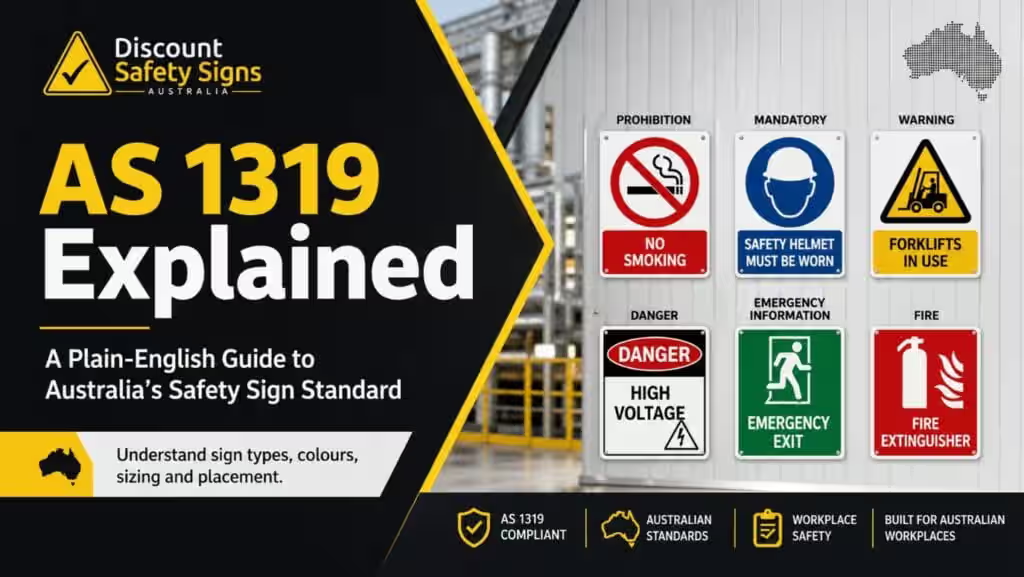
• Prohibition — “You must not.” Red circle with diagonal slash on white. No Smoking, No Entry.
• Mandatory — “You must.” Blue circle with white symbol. Hard Hat Must Be Worn, Hearing Protection Required.
• Warning — “Be careful.” Black symbol in a yellow triangle. Forklift Operating, Slippery Surface.
• Danger — “Immediate serious hazard.” White “DANGER” in a red oval over a black header. Danger High Voltage, Danger Confined Space.
• Emergency Information — White symbols on green. First Aid, Emergency Exit, Assembly Point.
• Fire — White symbols on red. Fire Extinguisher, Fire Hose Reel, Fire Alarm.
AS 1319 Colour Coding
Colour Meaning
Red Stop / Do not / Fire
Yellow Caution / Warning
Blue You must
Green Safety / Emergency
Sizing: The 15mm and 4mm Rules
A sign is only useful if it can be read. AS 1319 gives two simple rules based on viewing distance:
• Pictograms: at least 15mm per metre of viewing distance.
• Lowercase text: at least 4mm per metre of viewing distance.
So a sign read from 10 metres needs a 150mm pictogram and 40mm text minimum. Size up for low-light or outdoor conditions, and use reflective signs for low-light or roadside use.
Placement Basics
• At the point of the hazard, and at entry points to controlled areas.
• At eye level, free from obstructions, in adequate light.
• Maintained: faded, damaged or obscured signs are non-compliant.
Choosing the Right Material
AS 1319 specifies the design — you choose the substrate. Indoor offices: vinyl, poly or metal. Outdoor industrial: metal, aluminium or ACM. Coastal sites: aluminium or ACM (no rust). Public roads: Class 1 reflective on aluminium. Yards and carparks: Class 2 reflective.
AS 1319-Compliant Signs, Australia-Wide
Every standard safety sign we make at Discount Safety Signs Australia complies with AS 1319, on the substrate that suits your site.
Browse our full range at discountsafetysignsaustralia.com.au. Need help speccing it? Get in touch and we’ll talk you through it.
AS 1319 works as a visual communication system that ensures safety messages are instantly understood regardless of language or literacy levels. The combination of standardized colours, shapes, and symbols reduces interpretation time, which is critical in high-risk environments such as factories, construction sites, and warehouses. When applied correctly, it creates consistency across all Australian workplaces, reducing confusion and improving response times to hazards.
real site conditions like lighting, distance, and traffic flow.
Even fully compliant signs lose effectiveness if they become faded, dirty, obstructed, or incorrectly positioned after installation. Regular site inspections should confirm that signage remains visible, undamaged, and relevant to current hazards. Environmental conditions such as UV exposure, chemical contact, and high traffic areas should also influence material selection, ensuring long-term readability and compliance in real-world workplace conditions.