Your cart is empty.
Browse products

Blog
Exit Signs in Australia: A Quick Guide to Types and Compliance
If you own or manage a building in Australia, you need to know about exit signs — the green-and-white "running man" signs above egress doors. They look simple, but the rules behind them are detailed, and getting them wrong has serious consequences under AS/NZS 2293 and the National Construction Code.
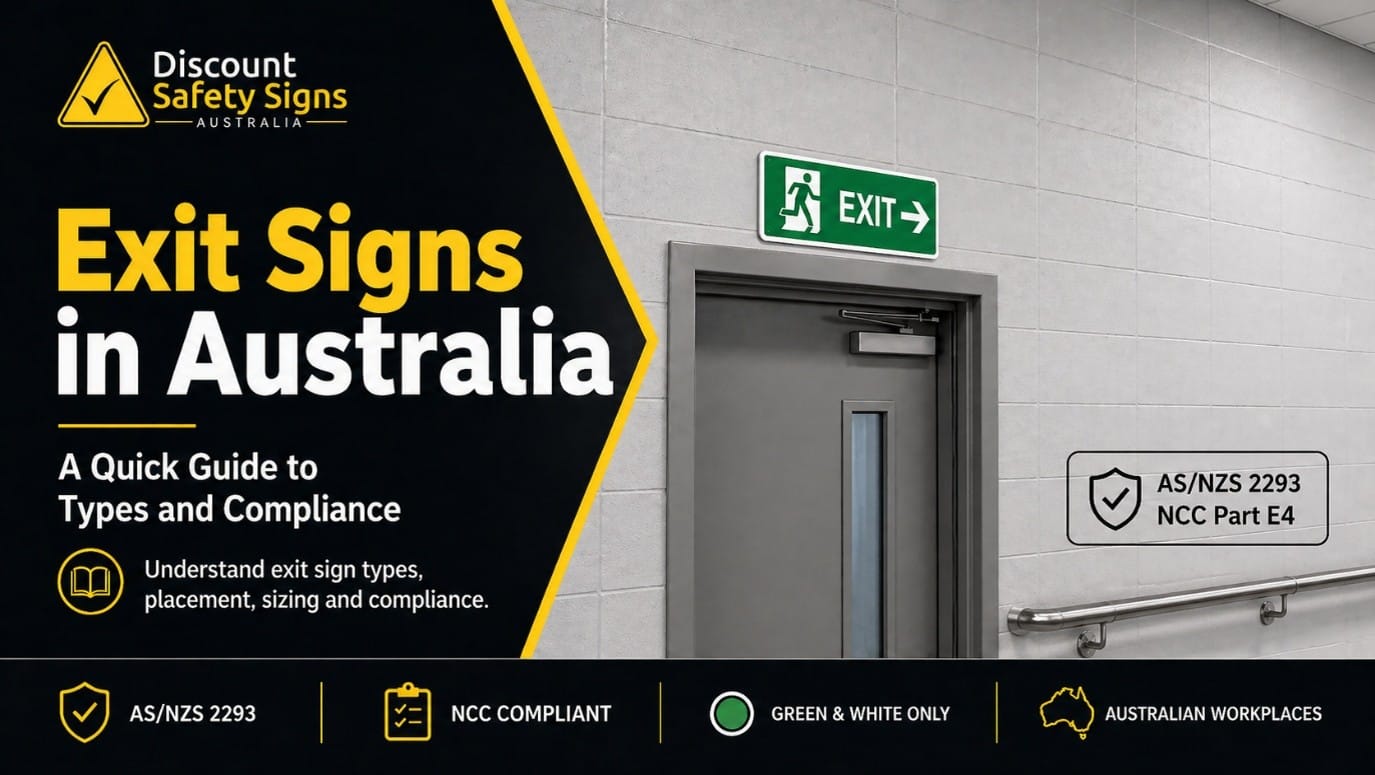
If you own or manage a building in Australia, you need to know about exit signs — the green-and-white “running man” signs above egress doors. They look simple, but the rules behind them are detailed, and getting them wrong has serious consequences under AS/NZS 2293 and the National Construction Code.
Key points in this article
- Exit signs are regulated by AS/NZS 2293 and NCC Part E4
- They are required at exits, direction changes, and escape routes
- Three main types: Electrical, Photoluminescent, Printed exit signs
- Electrical systems require 6-month testing and 90-minute battery backup
- Correct mounting height, size, and colour are strictly specified
The Standards: AS 2293 and the NCC
Two documents govern exit signs in Australia:
• AS/NZS 2293 — Emergency Lighting and Exit Signs for Buildings. Covers design, installation, maintenance and product specifications.
• The National Construction Code (NCC), Part E4. Makes AS 2293 a legal requirement in most non-residential buildings.
In short: if your building is covered by the NCC, AS 2293 isn’t optional.
Where Exit Signs Are Required
The NCC requires exit signs above each required exit door, at every change of direction along an escape route, above doors from enclosed stairways and passageways, and at decision points where the path of egress isn’t obvious.
The Three Types of Exit Signs
Illuminated (Electrical) Exit Signs. Hardwired LED signs with backup batteries that stay lit at all times and run for at least 90 minutes during a power outage. The default for offices, retail, hospitality, healthcare and most commercial buildings. Must be installed by a licensed electrician and tested every 6 months.
Photoluminescent (Glow-in-the-Dark) Exit Signs. Non-electrical signs that absorb ambient light and glow during a power failure. NCC-compliant under Specification 25 when correctly specified. No wiring, no batteries, no electrical testing — ideal for marquees, exhibitions, events and supplementary signage alongside electrical systems.
Non-Illuminated (Printed) Exit Signs. Standard printed signs on vinyl, poly, metal, aluminium or ACM. Used for reinforcement signage alongside compliant systems, wayfinding in carparks and yards, industrial and warehouse internal signage, and temporary or backup applications.
Sizing and Mounting Basics
• Mounting height: between 2 m and 2.7 m above floor level (or immediately above the doorway if higher than 2.7 m).
• Pictogram size: minimum 100 mm running-man height; size up for longer viewing distances.
• Colour: green and white only — the AS 2293 green chromaticity is specified.
Maintenance
Electrical exit signs require 6-monthly 90-minute discharge tests and an annual inspection under AS/NZS 2293.2, with logbooks kept on-site for 7 years. Photoluminescent and printed signs should still be checked regularly for fading, damage or obstruction.
Choosing the Right Exit Sign
• Commercial fitout? Electrical AS 2293 system (electrician-installed), with printed exit signs as supplementary wayfinding.
• Marquee or event? Photoluminescent.
• Industrial yard or carpark? Printed exit signs on aluminium or ACM.
Get the Right Exit Signs for Your Site
At Discount Safety Signs Australia, we manufacture printed and photoluminescent exit signs to suit a range of applications.
Browse our exit sign range at discountsafetysignsaustralia.com.au. Need help speccing it? Get in touch and we’ll talk you through it.
AS/NZS 2293 exit signs ensure compliant emergency lighting, safe evacuation routes, and legally required visibility across Australian buildings.
Exit sign systems are not only about installation but also about ongoing compliance and performance. Electrical systems must remain operational during outages, which is why backup battery testing and routine inspections are mandatory. Photoluminescent systems rely on stored light energy, making them suitable where wiring is impractical, while printed systems serve as supplementary or directional reinforcement in large or complex environments.
Always verify whether your building requires NCC compliance before choosing an exit sign type, especially for commercial or public-access properties.
Correct exit sign implementation also depends on visibility and placement strategy. Even when compliant products are used, incorrect mounting height, obstruction from fixtures, or poor lighting conditions can reduce effectiveness during emergencies. Regular inspection ensures signs remain visible, readable, and unobstructed at all times, maintaining both safety performance and regulatory compliance in real-world conditions.